Something New
The following below are all my something new, a project that allowed me to do whatever I wanted. For the fall semester, I had to do two something new: one that was textual and one that was non-textual. For the spring semester, I had to do three something new: one that was textual, one that was non-textual, and a collaborative one with other Humanities students. The page is organized by semester.
Fall Semester
Textual: Why John Locke would Support the Modern Welfare State
John Locke’s theory of political authority is based on two premises – human nature and natural rights. Human beings, he argues, are driven by their desire for self-preservation with reason constraining individuals from violating the rights of others. From this desire emerges the natural rights of life, liberty, and property which exist prior to government and define its purpose.
Liberty functions as a “fence” to protect life while property enables survival and enjoyment. Individuals consent to civil government not to surrender these rights, but to better protect them. In a state of nature, an individual is constantly at a state of war to protect their rights and possessions. The government replaces this threat of violence with stability, adjudication, and security. When the government violates these rights, Locke believes that it forfeits its legitimacy and the people then have a right to overthrow the government.
At first glance, this framework might support the view of a limited government only concerned with public order. However, Locke’s theory of natural rights contains stronger implications. His account of property assumed a world through which an individual can sustain themselves through their own labor. During Locke’s time, land was the primary source of wealth and while there was massive inequality, individuals could maintain some control over their sustenance. The Industrial Revolution, however, fundamentally altered this condition. As wage labor replaced land ownership, survival became dependent on employers rather than one’s own labor and resources.
Under these conditions, a person’s right to property is weakened. When individuals lack the means of survival, their rights to life and liberty become fragile as well. Dependence on employers for housing, income, and security undermines the freedom Loke sought to protect. A right that exists in theory but cannot be exercised in practice is not secured.
If the government exists to protect natural rights, then it must respond when conditions threaten them. Welfare provisions – such as universal healthcare or income support for those unable to work – do not contradict Locke’s framework but rather strengthen it. Those measures protect life by ensuring access to basic necessities, liberty by reducing coercive dependence, and property by enabling acquisition and maintenance. The welfare state exists to preserve and restore the meaningful exercise of natural rights.
While Locke would warn against onerous restrictions the government puts on these welfare programs, he would see the general welfare state as protecting fundamental rights. While extensive state intervention may have been seen as tyrannical in Locke’s seventeenth century England, the changes to economic life alters the obligations of the government. In a modern world where property acquisition cannot be independently conducted, government action becomes necessary to fulfill its foundational purpose. The welfare state, understood through Locke’s natural rights, does not diminish freedom but sustains it.
Non-Textual: The Exercise of the Law in and by the United States of America during the 21st Century and Subsequent Narratives

Credit: https://www.canva.com/
Spring Semester
Textual: Bodies, Discipline, and the Imperial Boomerang
Michel Foucault’s Discipline and Punish focuses on how disciplinary institutions and surveillance methods developed in Europe, noting a significant shift in the 17th and 18th centuries. During this period, modern systems of surveillance, bodily discipline, enclosure, and classification became common practice throughout the continent. At the same time, European countries were busy building exploitative empires abroad while competing against each other. In their colonies, Europeans employed methods of control and surveillance against colonized peoples and slaves. These countries used Enlightenment philosophy, especially Rene Descartes’ mind-body dualism theory and John Locke’s Second Treatise on Government, to justify their treatment of indigenous peoples. What Foucault describes in Discipline and Punish is not independent of events outside Europe: rather, he is showing the imperial boomerang in full force, the consequences of which we still experience in the modern-day.
In order to understand this story, we must first explore Descartes’ and Locke’s philosophy. In 1637, Rene Descartes posited his “mind-body dualism” theory, which can be summed up in the following quote: “I think, therefore I am.” In other words, the body becomes a vessel for the mind which is distinct and immaterial. The body merely becomes something to discipline and control, making it a secondary problem. John Locke adds on by defining human beings as having “reason,” distinguishing civilized individuals capable of participating in government and society. While not intended to justify colonization, their ideas were mobilized by Europeans to pursue their colonial projects, associating themselves with civilization while portraying colonized peoples and slaves as irrational and uncivilized. Because of this distinction, Europeans could legitimize domination and exploitation.
While these philosophies provided greater justification for empires, colonization was already in full force. Nowhere were systems of classification, surveillance, enclosure, and discipline better seen than on the plantation. The forms of bodily discipline Foucault described in the Docile Bodies Chapter through military drill had already been practiced on plantations. On the plantation, it was very clear who was slave and who was master. Slaves were constantly surveilled to make sure they were doing their jobs and to keep them entrapped. Their lives were tightly controlled, ensuring that they were making the most of their bodies for economic output. All of this was happening in a controlled space where every action was constantly monitored. The plantation system became the testing ground for systems of control, systems that would “boomerang” back to Europe.
The “imperial boomerang” was a concept introduced by French poet and politician Aimé Césaire. In his Discourse on Colonialism, he argued that Europeans tolerated centuries of colonial violence before being horrified when the violence was targeted towards them. Adolf Hitler’s tactics were shocking not because of the methods themselves, but because Europeans felt the consequences. In other words, the violence “bommeranged” from the colonies to the metropolis.
All of these methods of control, first formulated in the colonies and plantations and justified by Foucault and Locke, were brought back to the metropolis. Enclosure movements on farmland displaced peasants and enforced labor discipline. Prisons regulated bodies through confinement and surveillance. Police monitored populations considered dangerous or disorderly. Factories imposed strict routines and oversight on workers. Colonial systems of bodily control became the foundation of modern disciplinary society.
These systems were imposed to discipline bodies and force individuals to be as productive as possible. Foucault describes the efforts to discipline in his Docile Bodies Chapter. Raj Patel and Jason Moore, in A History of the World is Seven Cheap Things, show how capitalism required bodies to be organized, regulated, and controlled in order to have “cheap” labor. Discipline is integral to this system, and Patel and Moore describe how these systems came from the colonies to Europe in the context of the capitalist system.
These systems depend on the premise that the body is merely a vessel of the mind. As Foucault describes in the Panopticon chapter, Europe saw punishment systems transition from a focus on the body to a focus on the mind. The body is seen as something which needs to be used as much as possible for economic output as outlined in Foucault’s Docile Bodies chapter and broadly by Patel and Moore.
Réné Descartes’ idea of mind-body dualism and John Locke’s idea of reason was used by European colonists to justify their treatment of colonized peoples. At the same time, the plantation system was in full swing, and systems of control and surveillance were tested and refined in colonies. Eventually, these ideas “boomeranged” back to Europe and were imposed on European populations, impacting everyone in the metropolis. Michel Foucault in Discipline and Punish describes this shift happening in the 17th to 19th centuries, while Raj Patel and Jason Moore in A History of the World in Seven Things put the shift in the context of the rise of capitalism. Both authors are showing the imperial boomerang in effect, first introduced by Aimé Césaire. This boomerang continues to impact our world today, as we continue to experience the effects of surveillance and discipline in all walks of life, in punishment, education, and work, treating the body as secondary.
Non-Textual: Narratives Justify Systems of Control
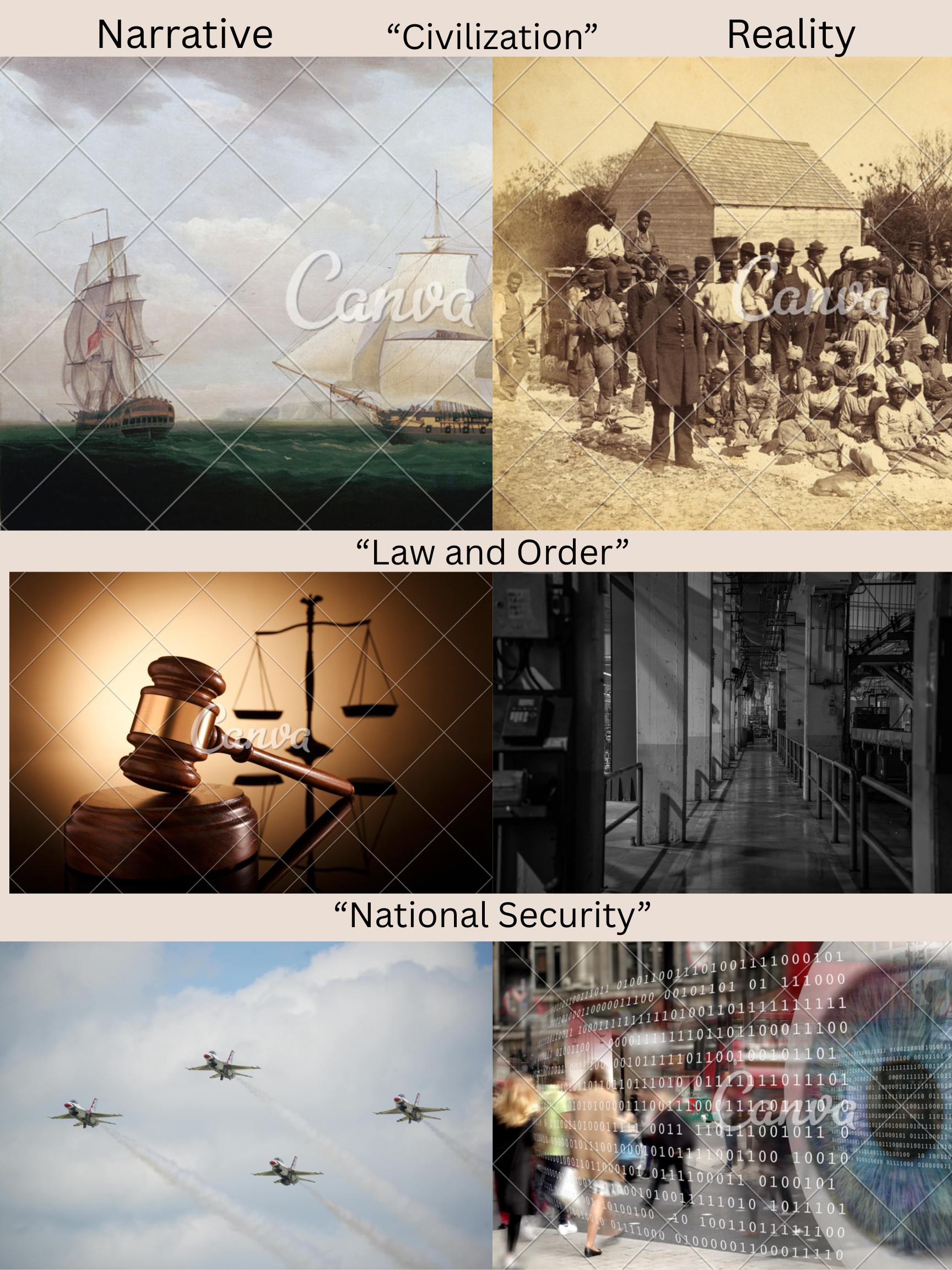
Credit: https://www.canva.com/
Collaborative: A Discussion About Portfolios with Spencer Mortell and Taddeo Simon
