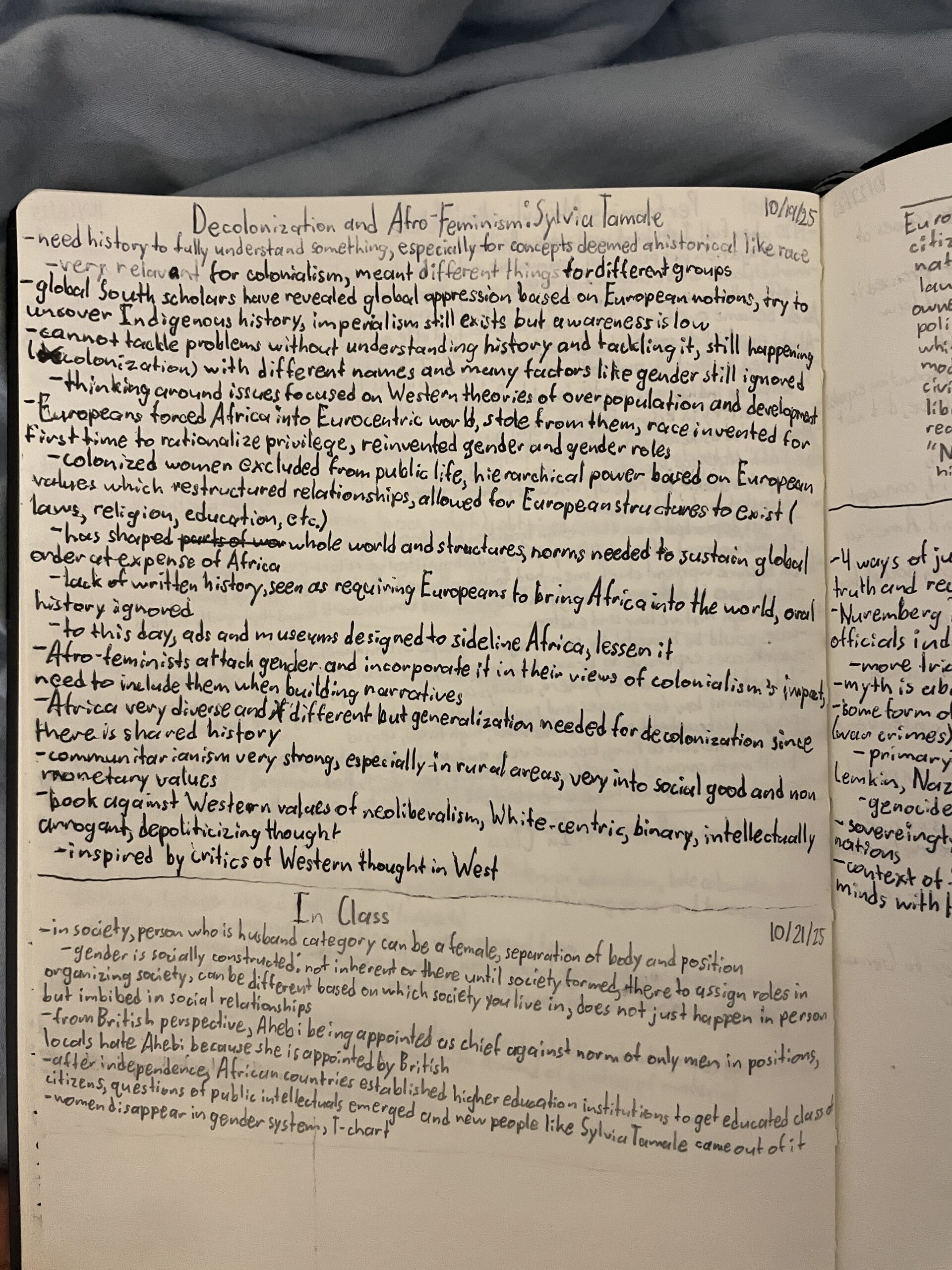
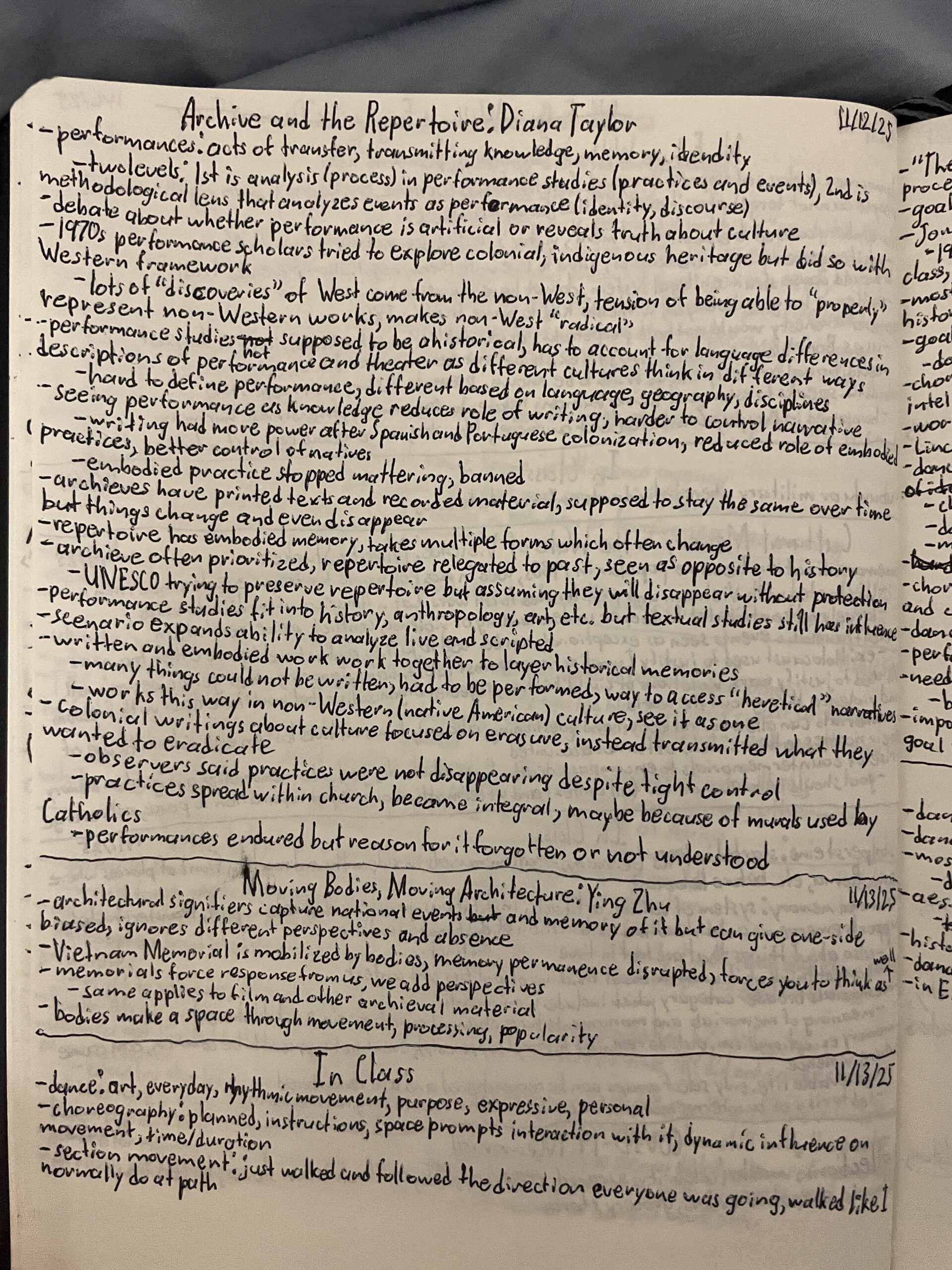
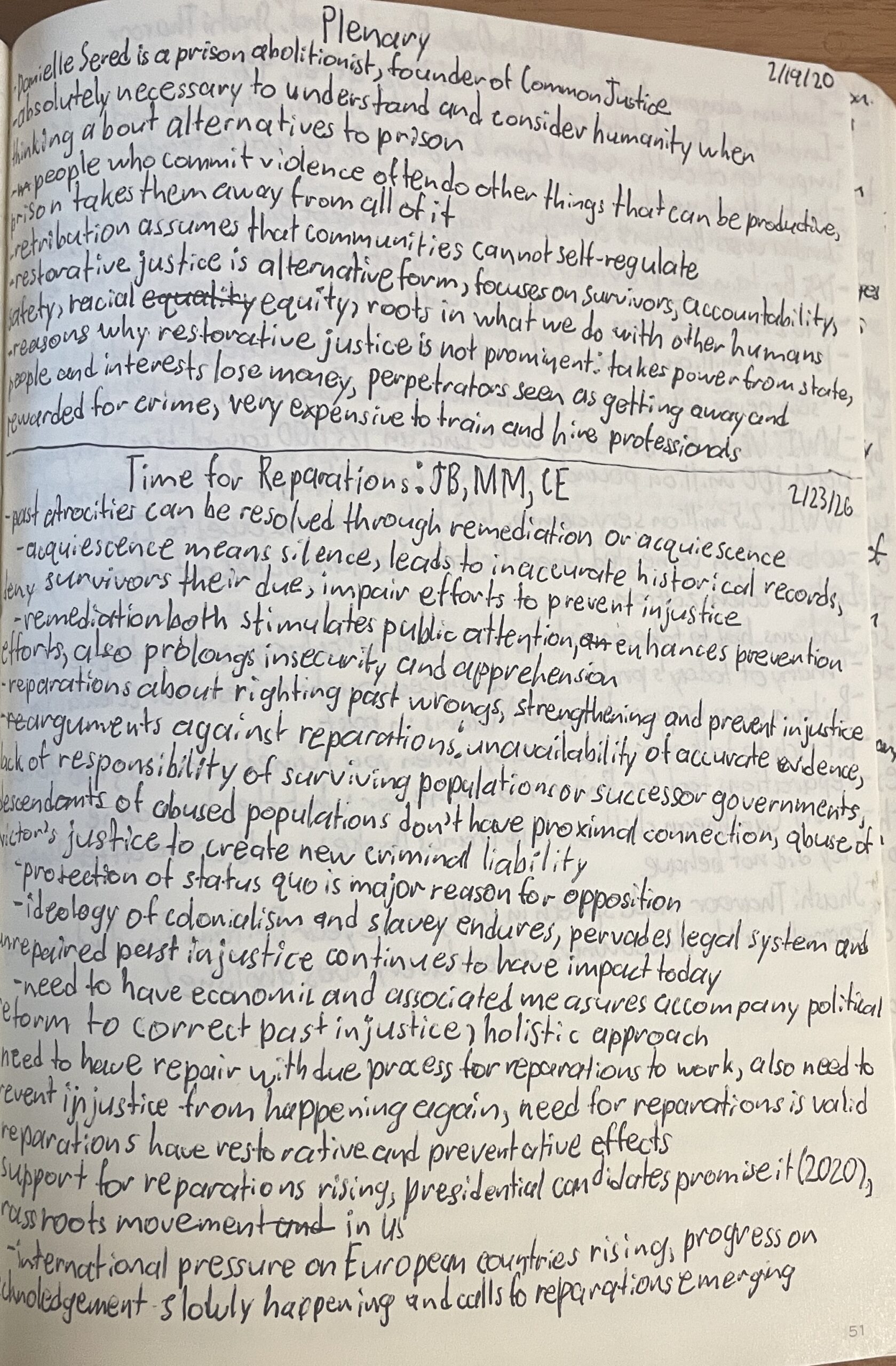
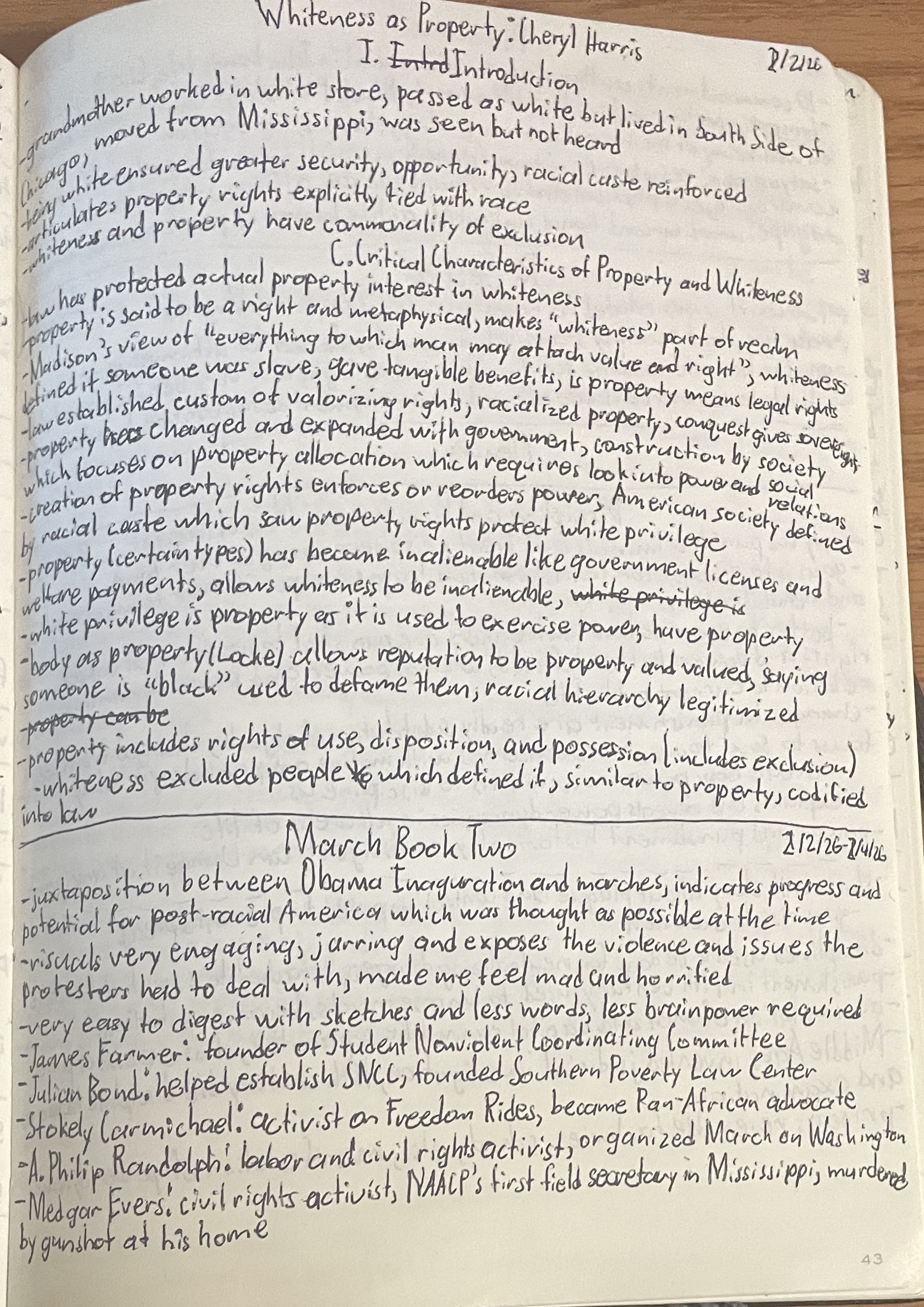
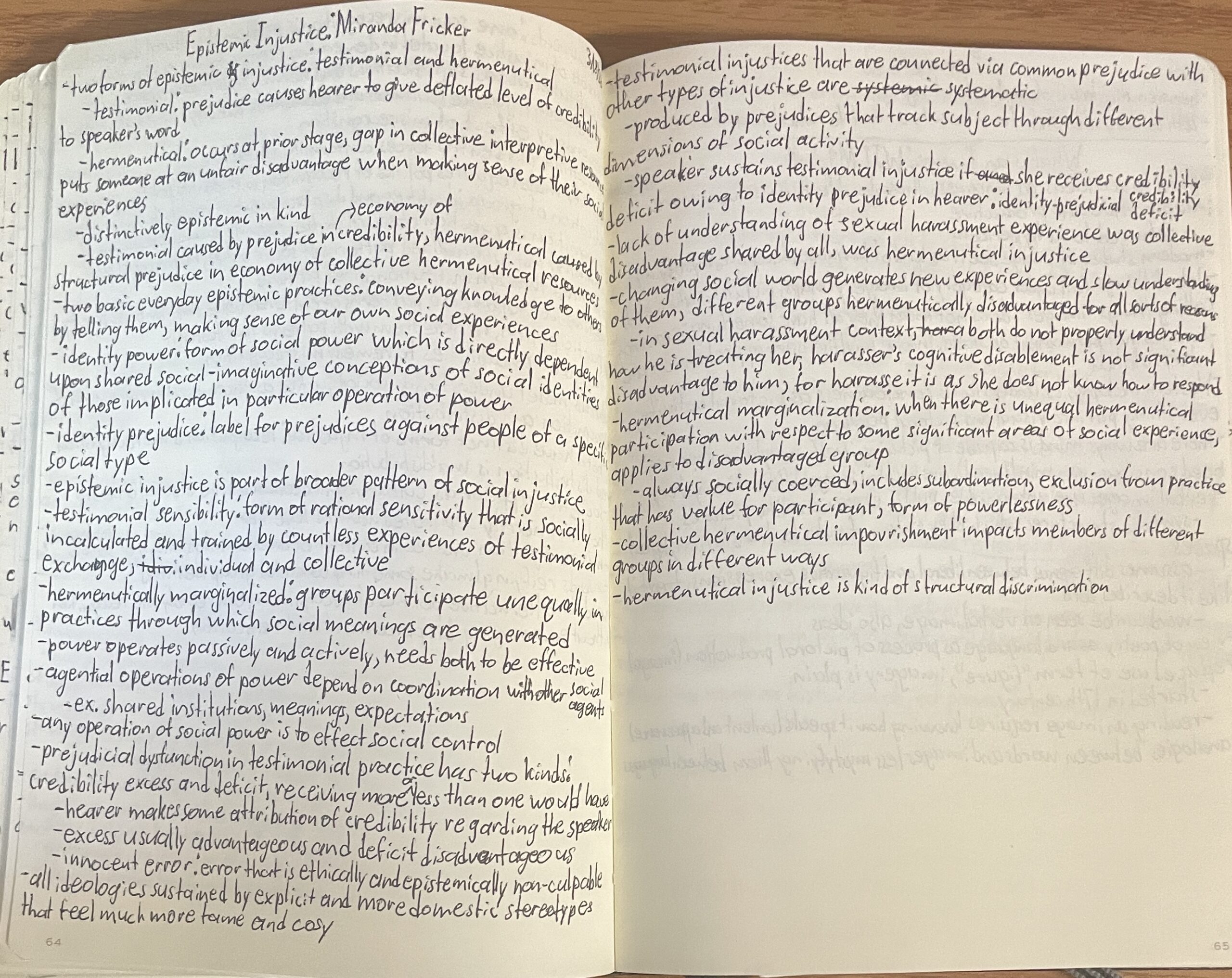
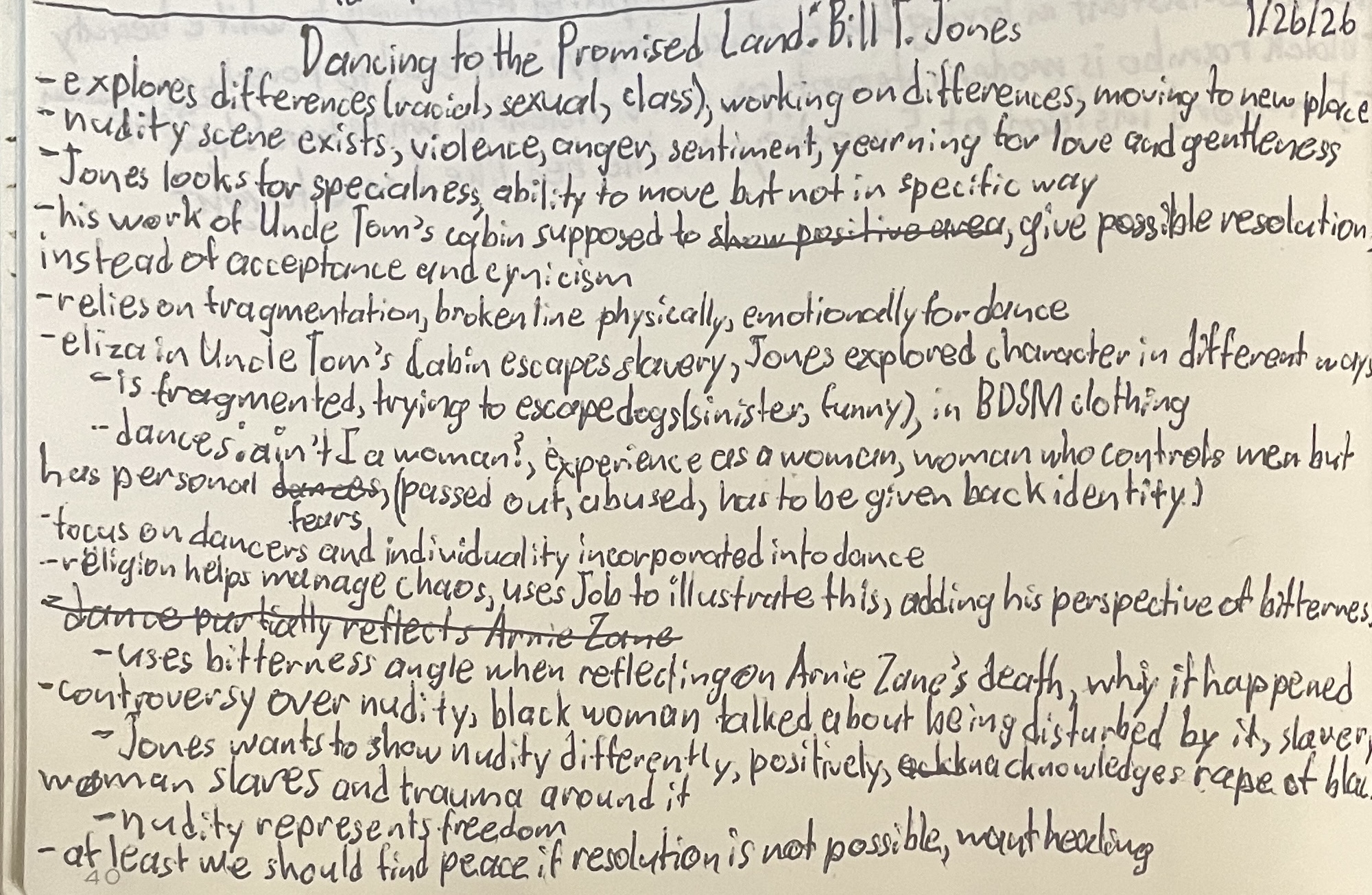
The following is my definition of justice, which references different works and units we examined throughout the year. There are also pages from my notebook which show my thoughts behind my definition.
Defining Justice
In a plenary on December 9, 2025, Dr. Lipsker said the following about justice: “When we think about justice, we think about slogans such as “No justice, no peace” and “environmental justice”. We do not think about the idea of legal justice.” The law is not always intertwined with justice and it has been used to justify and carry out heinous acts. While an action may be lawful, that does not make it right or just.
Justice requires getting the full story from both the perpetrator and the victim. In order to prosecute any court case or write an accurate history, one first has to properly evaluate the damage that has been done and build a narrative that accounts for all perspectives. While written and first-hand accounts are seen as the most common ways to record information, there are other ways to extract information. Film, song, dance, and oral stories have “embodied” knowledge and have been used for centuries to transmit information from generation to generation. From the Klezmer music tradition of Eastern European Jews in my fourth campus commentary to the film Ethnic Notions by Marlon Riggs, narratives have been embedded in non-textual sources for centuries, used for beneficial and malicious purposes, respectively.
Justice requires treating people with respect which differs depending on where one is from. In Western tradition, that would typically mean respect for people’s “natural rights” as John Locke puts it: life, liberty, and property. The purpose of the government is to protect these rights. By contrast, African jurisprudence is guided by the principle of ubuntu as author Panashe Chigumadzi has described in her work. Ubuntu, according to Chigumadzi in her blog post “With What are you Apologizing”, requires that if someone commits a crime, “you cannot seek forgiveness without giving something up as an act of your contrition.” Unlike in Western nations where a statute of limitations exists, a person or entity can be held accountable forever until they give something back.
Justice also requires treating people and different systems equally. According to former Supreme Court Justice William Brennan in his “Contemporary Ratification” speech, that requires treating people with dignity and interpreting the law to do so. Rights change as time goes on and the Constitution is designed in that way. Brennan fits squarely into Western legal tradition, which differs significantly from African and Latin American practices. Sylvia Tamale, in Decolonization and Afrofeminism, coined the term “legal pluralism” to describe these differences. While African jurisprudence follows ubuntu, Latin American knowledge was transferred through, as Diana Taylor put it, the “repertoire”. The repertoire encompasses performance as an instrument in the transfer of knowledge. It was because of this and the lack of written work that European colonizers in Latin America and Africa treated Africans differently, thinking they were inferior. As Michel-Rolph Trouillot wrote in Silencing the Past, “Some Europeans and their colonized students saw in this alleged absence of rules the infantile freedom that they came to associate with savagery…” (7). Individuals should not be treated differently just because of their physical features or cultural differences.
Justice requires accountability for all sides. Instead of a “victor’s justice” as Mahmood Mamdani described the International Military Tribunal in Nuremberg after World War II in Neither Settler nor Native, everyone who has participated or played a major role in a crime should be held accountable. If that requires the victor to hold people to account in order to get a full picture of the crimes committed, something that Mamdani would support, then it should happen. While the punishments might differ, especially if the crimes are different like in Dante’s Inferno, full accountability would serve as a disincentive to not commit the same crime and strengthen systems of accountability and their ability to serve justice.
Justice demands recognition and redress for those who were wronged. It requires ensuring that an event in question is remembered in a way that reflects the experiences of both sides of the matter in order to give an accurate picture for generations to come. This can be done through more than just written text. Graphic novels, like March Book 2, and documentaries such as How to Survive a Plague show us the value of pictures and film in telling stories, making the material easily digestible for all. It also requires that any barriers to equality and full legal rights be removed, as they were done through emancipation of slaves in the United States and granting full civil and voting rights during the civil rights movement. However, that is not enough to redress injustice. Redress requires the use of reparations in order to allow the oppressed group to substantively exercise their newfound rights. As Jacqueline Bhabha, Margareta Matache, and Caroline Elkins wrote in Time for Reparations, “Emancipation from slavery without attendant land reform and restitution of the stolen wealth generated by centuries of slave labor did not put formerly enslaved populations in a position to resist exploitative labor contracts post emancipation” (4). Without reparations, cycles of violence and discrimination continue as the formerly legally oppressed group continues to be unable to exercise their rights.
Finally, justice requires us to think of ways to create more just futures. This can be shown in multiple ways. For one, it requires us to see art as a venue for messaging and expression. As Dr. Corso-Esquivel showed through the artworks, the way we view people and events can change significantly based on colors and surroundings. It allows us to humanize human beings. Art can also express hermeneutical injustice, which Miranda Fricker defines as, “a gap in the collective interpretive resources which puts someone at an unfair disadvantage when making sense of their social experiences” (1). Dr. Corso’s artworks show us how art can help mitigate the issue of hermeneutical injustice and gives an avenue to show stories. Dance is also another example. In Dancing to the Promised Land, Bill T. Jones uses it to depict his emotions over the loss of his partner Arnie Zane while giving a message of hope and possible resolution rather than just acceptance and cynicism. Finally, in “A Future of Creative Placemaking”, it shows how art can work to create positive outcomes in different fields “ranging from public health to economic development, and from immigration to food and agriculture” (1). Not only can art allow us to envision the future, it can help create it.